
Why Foundation Certifications Are Required on Manufactured Homes
Mitch Lowry | March 8, 2026
Manufactured homes can be excellent housing options, but when financing is involved, buyers, lenders, and underwriters often want proof that the home is properly installed on a permanent foundation. For FHA-insured manufactured home loans, HUD says the foundation must meet the Permanent Foundations Guide for Manufactured Housing, and the certification must be completed by a licensed professional engineer or registered architect licensed in the state where the home is located. HUD also says the certification must be site-specific and include the professional’s signature, seal if required, and license information.
The reason this matters is simple: the foundation is not just holding the home up. It also has to resist vertical loads, wind-overturning forces, ground movement, and long-term settlement. USDA guidance likewise treats manufactured homes as a special property type and requires foundation-related documentation in the lender’s file, including plan/spec compliance and footing/final inspections or equivalent documentation, depending on the program path. VA guidance for permanently affixed manufactured homes also requires the unit to be attached to a permanent foundation system capable of resisting both supporting loads and wind-overturning loads.
In plain English, a foundation certification is often required because the people involved in the transaction want written proof that the home is permanently supported, properly anchored, and likely to perform as intended over time. That becomes especially important when the home is being purchased, refinanced, or sold to a buyer using financing tied to permanent-foundation standards.
What Engineers Are Looking For
When an engineer evaluates a manufactured home foundation, they are usually not focused on cosmetic items. They are looking for structural and installation details that affect safety, durability, and loan eligibility. HUD’s guidance and related audit findings repeatedly center on four major categories: perimeter enclosure, piers, footings, and anchorage.
1. Footings
The engineer wants to see that the load is being transferred to the ground properly. USDA’s site-built permanent foundation language describes a system of footings, piers, caps, shims, and anchoring devices or structural connections that transfer loads to the earth below frost depth without exceeding safe soil bearing capacity.
That means they may look for:
Proper footing size
Reinforced concrete where required
Adequate bearing on firm soil
Depth below frost line where applicable
Signs of settlement, movement, or undermining
2. Piers and supports
Piers support the chassis and distribute weight into the footing system. HUD’s audit findings note that dry-stacked masonry piers were not acceptable under the guide; mortared joints were required in the examples cited.
An engineer may check for:
Proper pier spacing
Correct block orientation and construction
Mortared joints where required by the applicable standard
Sound caps, shims, and bearing points
No obvious crushing, rotation, or displacement
3. Anchorage
This is one of the biggest issues. HUD’s audit summary says anchoring devices must permanently attach the home to the foundation and be adequate to resist loads including uplift, wind, earthquake, and ground movement. It also specifically notes that anchoring straps or cables attached only to ground anchors other than footings or piers do not meet the permanent-anchorage requirement for FHA, and screw-in soil anchors are not considered permanent anchorage for that purpose.
In other words, an engineer is often looking for more than “it has tie-downs.” They want to know whether the tie-down system is part of a true permanent foundation design.
4. Perimeter enclosure and crawlspace conditions
HUD’s audit also emphasized the need for a properly enclosed crawlspace using permanent foundation-type construction, not light vinyl skirting used as a substitute for a qualifying foundation enclosure. Ventilation, moisture control, access, and exclusion of vermin also matter.
Examples of Tie-Downs and Securing Methods
Not every manufactured home uses the exact same system, but here are common examples buyers and agents may see.
Frame anchors with straps or rods
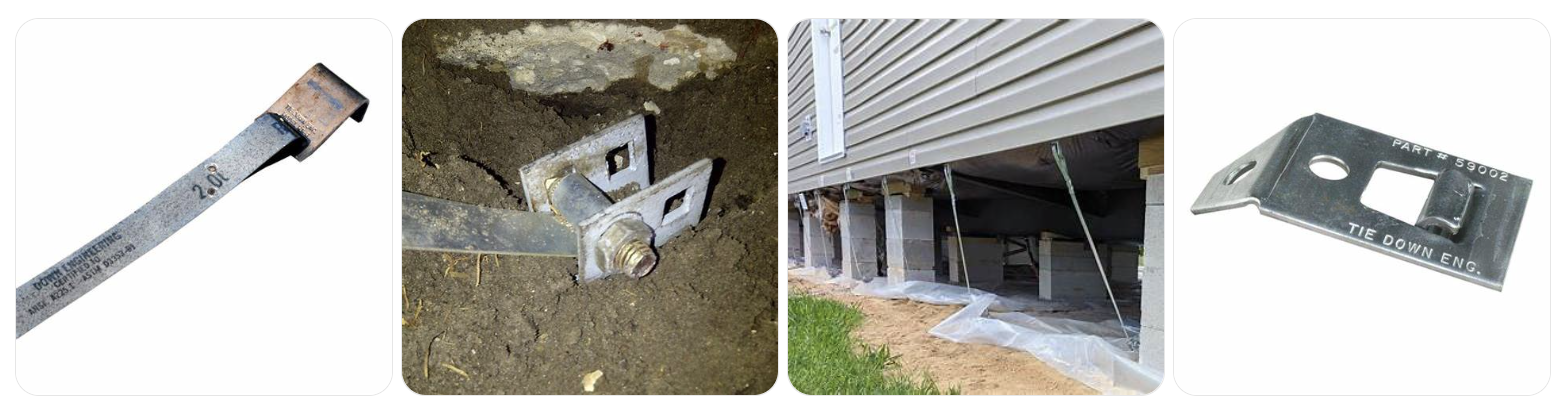
These connect the chassis or frame to engineered anchorage points in or connected to the foundation system. In HUD’s foundation examples, the anchorage system must be clearly shown in both transverse and longitudinal directions, with required values checked against manufacturer or product ratings.
Diagonal strap bracing
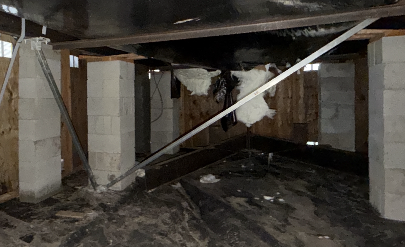
Some systems use diagonal steel straps in X-brace configurations between supports to resist lateral movement. HUD’s sample problems specifically discuss vertical X-bracing planes and checking whether the rated strap capacity exceeds the required tension force.
Anchored piers and concrete deadmen
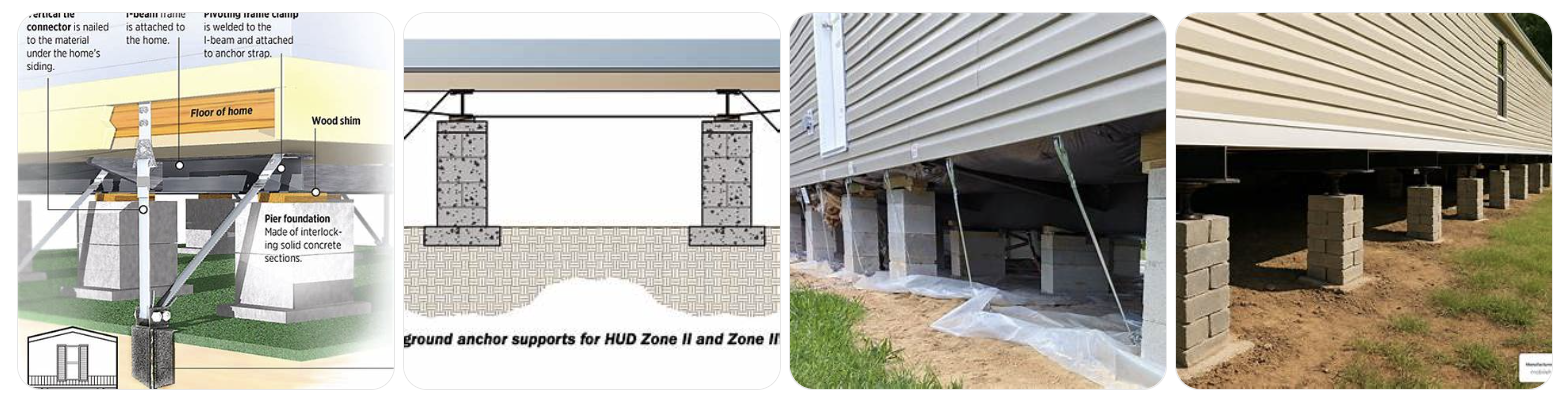
In some engineered systems, anchorage may be tied into concrete footings or “deadman” elements rather than simple soil anchors. HUD’s examples discuss concrete deadman footings, anchor bolt sizing, and verifying required loads.
Foundation walls with structural connections
Some manufactured homes are set on perimeter foundation walls or crawlspace walls with connections that provide both vertical support and resistance to overturning and lateral loads. USDA describes permanent foundation systems as combinations of footings, piers, caps, and anchoring devices or structural connections designed to support all applicable loads.
What Usually Causes a Home to Fail Certification
A manufactured home may have lived on the site for years and still fail a lender-required foundation review. Common reasons include inadequate footings, pier problems, non-permanent anchorage, missing or insufficient connections, or skirting that looks substantial but does not qualify as a permanent enclosure. HUD’s audit of FHA-insured manufactured homes found repeated issues in exactly those areas: perimeter enclosure, piers, footings, and anchorage.
Another common problem is assuming that “tied down” automatically means “certifiable.” That is not always true. A home can have straps or anchors present and still fall short if the system is not site-specific, not permanently attached to the foundation, not adequate for the required loads, or not documented in a way acceptable to the lender or program.
Why This Matters to Buyers and Sellers
For buyers, the certification can help prevent surprises after closing. For sellers, it can keep a transaction from stalling when the buyer’s lender asks for proof late in escrow. For agents, it is one of those issues that is worth identifying early, especially if the buyer is using financing that expects a permanent foundation and real-property treatment. VA materials also state that manufactured homes on permanent foundations must be classified and taxed as real property.
The bottom line is that foundation certifications are required because lenders and agencies want evidence that the manufactured home is not simply sitting on blocks or temporary tie-downs, but is installed in a way that properly supports the structure and resists movement over time. A qualified engineer is looking at how the home bears on the ground, how it is supported, how it is anchored, and whether the overall system appears consistent with permanent-foundation standards.
Important note: exact certification needs can vary by loan type, lender overlays, local jurisdiction, and whether the assignment is for purchase, refinance, or an existing installation review. This post is general educational information, not engineering or lending advice.